
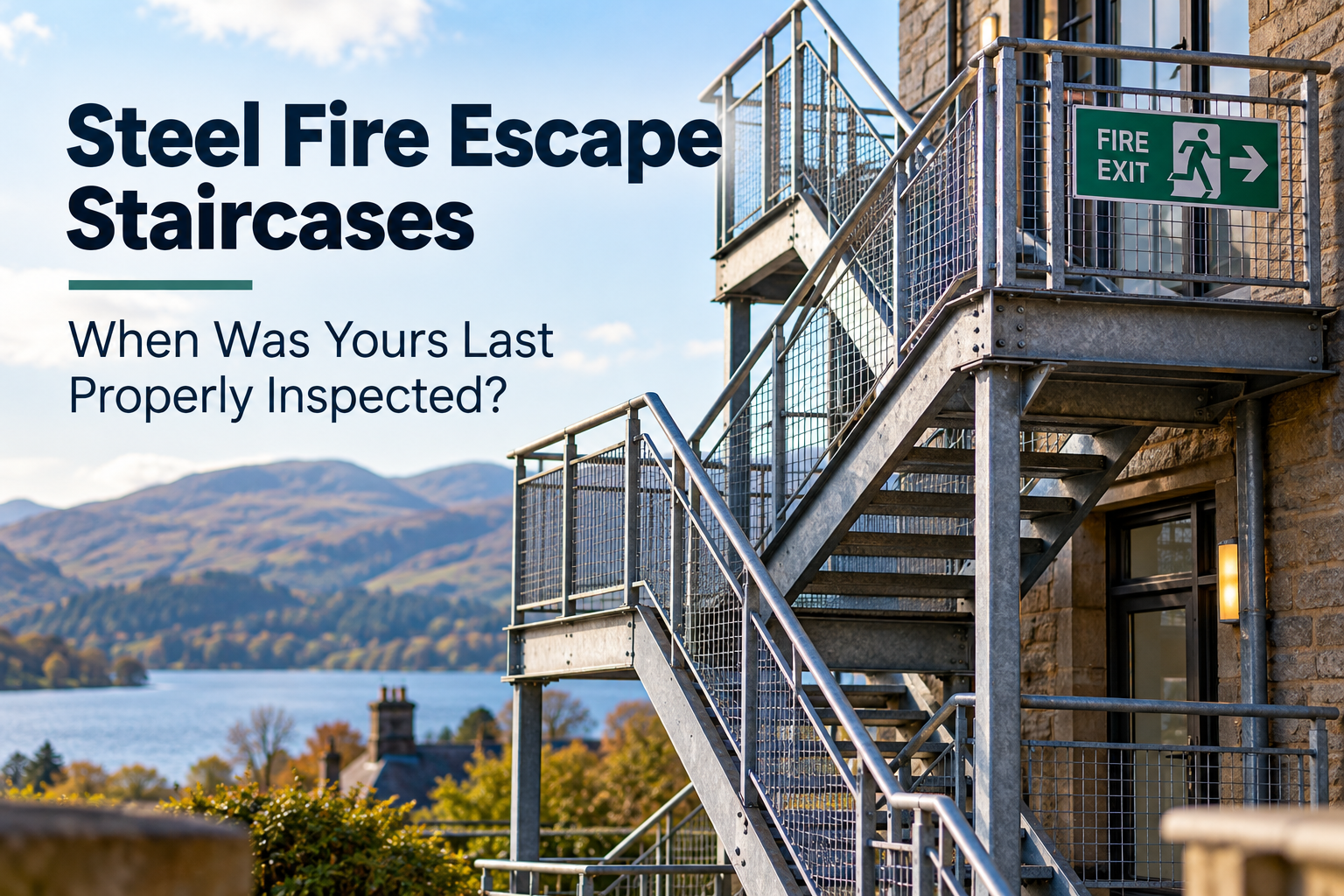
Steel Fire Escape Staircases – When Was Yours Last Properly Inspected?
Steel Fire Escape Staircases – When Was Yours Last Properly Inspected?
Fire alarms get tested. Emergency lighting is checked. Fire extinguishers have service dates attached to them.
But what about the steel staircase bolted to the outside of the building?
For many hotels and hospitality businesses across Cumbria, the Lake District and Scotland, an external steel staircase forms part of the building’s means of escape. In some properties, it may only ever be used in an emergency.
That is probably one of the reasons these staircases can be so easy to forget about.
They sit outside year after year, exposed to rain, frost, wind and changing temperatures. Corrosion can develop slowly, paintwork can break down and fixings can deteriorate without anyone really noticing.
If that staircase forms part of your fire escape route, though, it needs to be safe and usable when people actually need it.
What about the five-year inspection?
You will often hear five years mentioned when external steel fire escape staircases are discussed.
That comes from BS 8210:2020, which is commonly referenced as recommending a structural survey of external fire escape stairs at intervals not exceeding five years, carried out by a competent person.
That does not mean the staircase should be looked at once every five years and ignored in between.
Its condition, age, location, previous defects and the findings of your fire risk assessment may mean it needs attention sooner.
There are also situations where more frequent specialist inspections may be appropriate. Some Scottish fire safety guidance, for example, refers to three-year structural integrity surveys in certain types of specialised housing.
For a hotel, particularly one accommodating sleeping guests, I would expect the staircase to be included in routine building checks as well as having the appropriate specialist inspection carried out at the correct interval.
Why are these staircases so easily overlooked?
It is not difficult to see how it happens.
Your fire alarm contractor reminds you when the service is due. Gas and electrical inspections come with certificates, reports and renewal dates. Emergency lighting is normally built into a planned maintenance schedule.
The external fire escape is different.
It can simply become part of the building.
If it is rarely used, nobody may walk down it for months at a time. Meanwhile, water can collect around joints, protective coatings can deteriorate and corrosion may start in areas that are difficult to see from above.
By the time somebody notices something obvious, the deterioration may have been developing for quite a while.
What can hotel staff look for?
You do not need to be a structural engineer to carry out a basic visual check.
The purpose is not to decide whether the staircase is structurally sound. It is simply to notice when something has changed or looks as though it needs professional attention.
Things worth looking out for include:
- Rust and corrosion, especially around joints, welds, bolts, supports and connection points.
- Flaking or damaged paintwork, particularly where bare steel is becoming exposed.
- Loose handrails or balustrades, or anything that moves when it should not.
- Damaged or badly corroded treads and landings, including areas underneath the structure.
- Standing water, moss or algae, which may also create a slip hazard.
- Cracks or deterioration around concrete bases and anchor points.
- Any unusual movement, vibration or change in the structure when it is being used.
- Stored items, vegetation or other obstructions affecting the escape route.
It is also worth checking the route all the way to the final place of safety.
There is little point having a usable staircase if the route at the bottom is blocked or difficult to access.
If something does not look right, do not simply make a note and wait until the next scheduled inspection.
Get it looked at.
Who should carry out the inspection?
For a proper structural assessment, you would normally be looking for a structural engineer or structural engineering consultancy with experience in external steelwork and fire escape staircases.
There are also specialist businesses that carry out fire escape staircase inspections. What matters is that the person carrying out the assessment is suitably competent to inspect the structure and identify whether further investigation or repairs are needed.
A proper inspection may look at things such as corrosion, loss of steel section, welds, connections, supports, fixings, movement and the general stability of the staircase.
If repairs are required, that work may then involve a structural steelwork contractor, metal fabricator or specialist steelwork company, usually working from the engineer’s recommendations.
For hotels and hospitality businesses across Cumbria, Carlisle, the Lake District and Scotland, this is one of those areas of building compliance that can easily disappear into the background.
The staircase is there every day, so everyone assumes it is fine.
It is worth asking the question anyway:
When was the last time somebody suitably qualified actually inspected the structure properly?
Hospitality Secured
Operations Support | Building Compliance | Food Safety | Health & Safety
Practical support for safer, stronger hospitality businesses.